
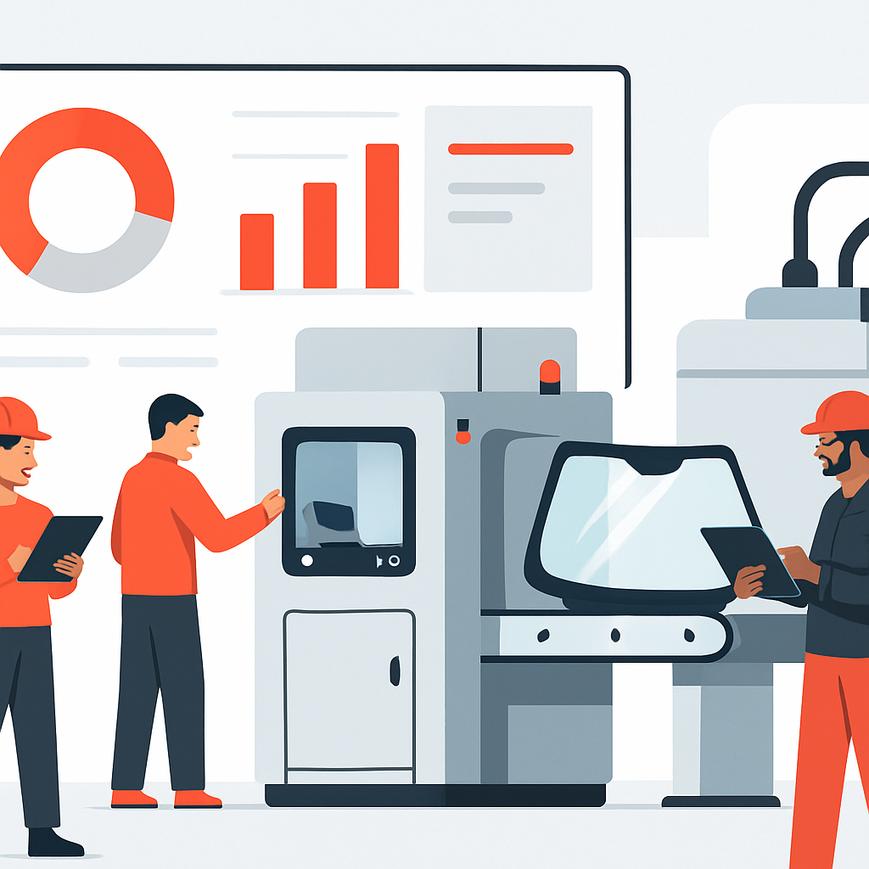
In the windshield glass industry, the distinction between OEM (Original Equipment Manufacturer) andOEE (Overall Equipment Effectiveness ) may seem complex, but it is crucial. OEM focuses on producing parts to original standards, while OEE evaluates overall equipment efficiency. It is imperative for production managers to optimize OEE to cope with increasing quality demands and competition. Their efficiency largely determines the profitability of production lines and their ability to adapt to market needs.
Analyzing the causes of poor OEE performance often reveals intrinsic problems linked to machine downtime, reduced production speeds and quality defects, directly impacting productivity and manufacturing costs. When machines are not operating at optimum capacity, downtime increases, not only lowering OEE, but also increasing production costs and reducing the company’s overall competitiveness. By optimizing OEE, a company can reduce these costly drifts.
To improve OEE, it is essential to adopt continuous improvement methods such as TPM (Total Productive Maintenance), and to digitalize production monitoring.
An exemplary case study from a windscreen glass production plant showed a significant improvement following the implementation of a digital OEE monitoring solution. Optimization of production parameters led to a 20% reduction in downtime and a 15% increase in productivity. Continuous data analysis led to better resource allocation and enhanced quality control, demonstrating the importance of performance analysis in improving synthetic yield rates.
In conclusion, OEE optimization is an essential lever for increasing the competitiveness and profitability of windshield glass manufacturing plants. For plant and production managers, it is imperative to structure a project around TRS/OEE, aimed not only at measuring and analyzing, but above all at continuously improving processes. With powerful tools like those from TeepTrak, companies can turn these challenges into opportunities for sustainable, efficient growth.
FAQ
Question 1: How does the OEE impact windshield glass production?
The OEE has a direct impact on productivity by identifying time lost due to stoppages, performance and quality, giving managers the levers to optimize their production lines.
Question 2: Why is it essential to improve OEE?
Improving OEE is crucial to reducing costs, improving quality and increasing global competitiveness. It enables companies to identify and correct inefficiencies in their operations.
Question 3: Where to start improving OEE?
Start with a detailed analysis of production stoppages and quality defects. Using a real-time tracking system like TeepTrak can help to quickly identify sources of lost efficiency.



0 Comments