
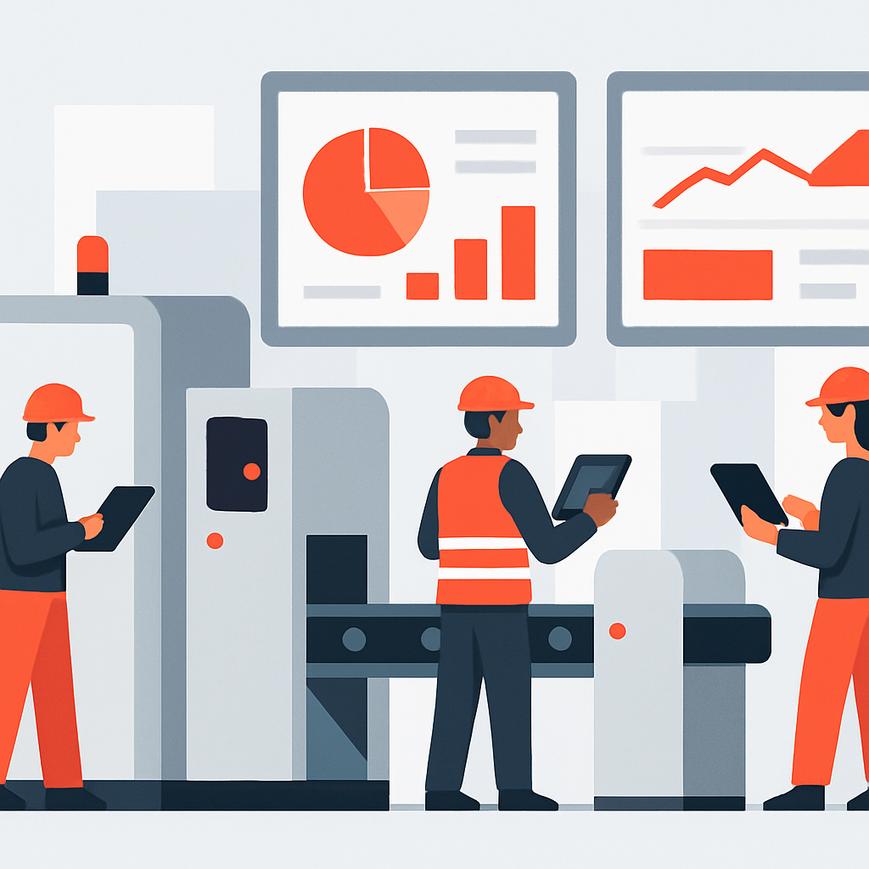
In today’s industrial landscape, production performance is an essential pillar of competitiveness. One of the most complex challenges is calculating OEE TEEP (Overall Equipment Effectiveness – Total Effective Equipment Performance), which helps to measure the efficiency of your equipment. Understanding and improving this indicator is crucial to optimizing production, reducing costs and minimizing downtime. Yet many plants struggle to deploy a precise method for calculating and interpreting OEE TEEP, limiting their ability to target potential improvements.
Difficulties in calculating OEE TEEP often stem from a lack of understanding of influencing factors such as availability, performance and quality. A lack of accurate data and inadequate integration of monitoring systems can lead to errors in the analysis of these metrics. These shortcomings translate into significant productivity losses, sub-optimal OEE, and increased costs associated with unplanned downtime and non-quality.
To overcome these challenges, the adoption of practices such as continuous improvement and the digitization of the shop floor is becoming essential. The integration of tools such as those offered by TeepTrak facilitates real-time monitoring, accurate data collection and multi-line visibility. Automation and connectivity enable equipment efficiency to be closely monitored using reliable indicators. Assimilating these technologies can lead to rapid identification of bottlenecks and appropriate corrective action.
One inspiring example is an electronics manufacturing plant that transformed its processes by integrating TEEP tracking with TeepTrak. Faced with below-average yields, they implemented real-time monitoring that revealed frequent stoppages on the main line. These results prompted them to align their preventive maintenance programs, increasing their OEE by 15% in just six months. Reliability gains also helped to reduce production rejects and thus improve overall quality.
In conclusion, a proactive approach to calculating and improving OEE TEEP starts with accurate measurement and analysis of industrial performance. Plant managers can significantly improve their operations by turning to comprehensive digital solutions like TeepTrak. Start by identifying your key performance indicators, train your teams in the innovative tools available, and adopt a TRS/OEE steering approach to transform your results.
FAQ
Question 1: How can I calculate the OEE TEEP efficiently?
To calculate OEE TEEP effectively, use accurate data collected via a real-time tracking system like TeepTrak. Make sure you cover the three fundamental aspects: availability, performance and quality. Each factor must be measured and adjusted according to the production standards specific to your industry.
Question 2: What impact can an incorrect OEE TEEP calculation have on a plant?
Incorrect calculation of OEE TEEP can lead to incorrect assessment of your equipment’s efficiency, resulting in unplanned downtime and loss of yield. This can increase operating costs and adversely affect the quality of finished products. Using automatic monitoring tools can reduce these errors.
Question 3: Where do you start to improve your OEE TEEP?
Start by engaging your teams in understanding the components of OEE TEEP. Identify problem areas through accurate diagnostics, then launch training initiatives on real-time tracking technologies. Prioritize preventive maintenance and constantly monitor performance using solutions such as TeepTrak.



0 Comments