
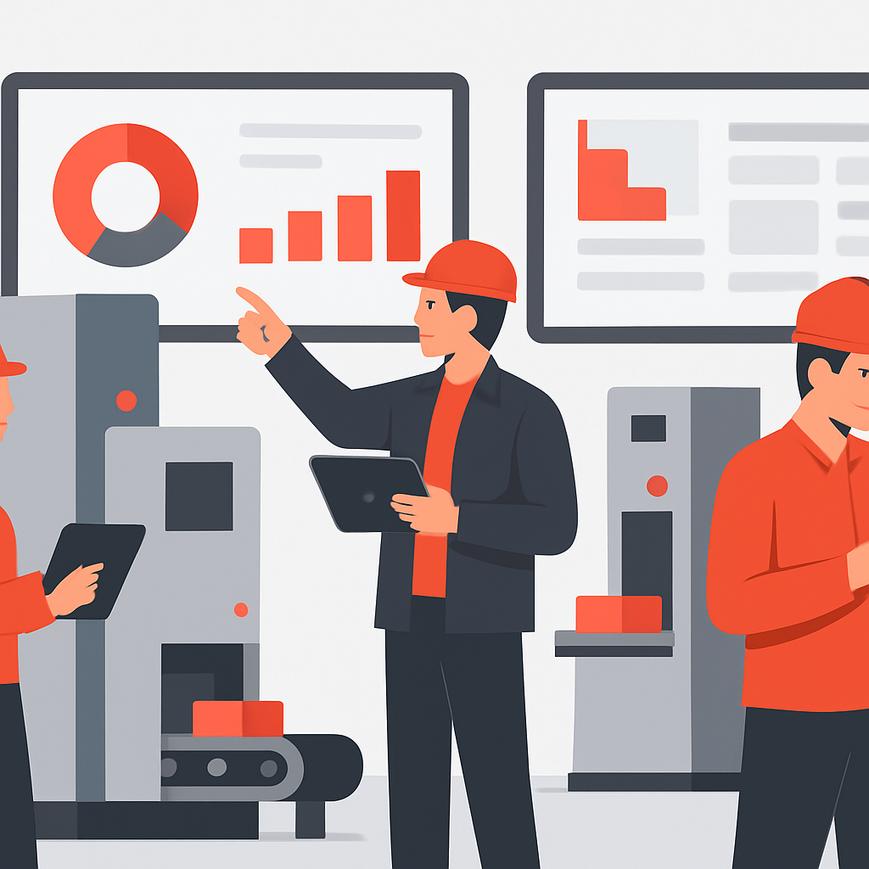
In the industrial sector, the terms OEE (Overall Equipment Effectiveness) and OEU (Overall Equipment Utilization) are often used to assess equipment performance. However, understanding the difference between these two indicators is crucial for production and industrial managers. OEE, or Overall Equipment Effectiveness, focuses on maximizing productivity by taking into account equipment efficiency, quality and utilization. Conversely, OEU focuses primarily on machine utilization, without integrating quality and performance aspects. This distinction is critical, since neglecting an aspect such as quality can have repercussions on customer satisfaction and lead to significant non-quality costs.
Lack of clear differentiation between OEE and OEU can lead to analysis errors, negatively influencing production strategy. An exclusive focus on OEE can lead to over-utilization of machines, increasing the risk of breakdowns and corrective maintenance, with a direct impact on downtime and, consequently, on the plant’s overall OEE/OER. The consequences of misunderstanding also have an impact on operating costs, with higher expenditure on unscheduled repairs and lower productivity in terms of finished product quality.
To overcome these challenges, manufacturers need to adopt a holistic approach integrating shop-floor digitization and continuous improvement methods. The use of tools such as those offered by
A concrete success story is that of an automotive parts manufacturing plant which, thanks to TeepTrak, was able to identify an under-utilization problem on one of its production lines. By analyzing data in real time, the team adjusted preventive maintenance schedules and modified production cycles to maximize OEE. This led to a 15% reduction in downtime and a significant increase in product quality, demonstrating the impact of good monitoring practices.
In conclusion, clearly differentiating OEE and OEU is essential to optimizing industrial performance. Plant managers should consider setting up a dedicated TRS/OEE project, capable of continuously improving productivity and quality. Using digital solutions, such as those from
FAQ
Question 1: What is the difference between OEE and OEU?
The OEE evaluates equipment efficiency by integrating availability, performance and quality, while the OEU focuses solely on utilization.
Question 2: How does OEE impact industrial performance?
By optimizing the OEE, you can reduce downtime, increase product quality and boost competitiveness.
Question 3: Where do we start to improve our OEE?
Start by analyzing existing data, identifying bottlenecks, and using digital solutions to monitor and improve performance.



0 Comments