

Understanding and optimizing OEE (Overall Equipment Effectiveness) is crucial for any plant seeking to maximize production performance. As a key measure of efficiency, OEE helps identify performance losses, whether in downtime, production speed or quality. A typical ‘oee question paper’ can ask questions about best practices for improving this essential parameter, which is critical for anticipating bottlenecks and optimizing resource utilization in an increasingly competitive industrial environment.
The root causes of inefficiencies in OEE mainly include frequent and unplanned stoppages, production speeds below rated capacities, and quality defects which increase non-quality costs. These factors have a direct impact on productivity and increase operating costs. Failure to address these issues results in significant potential revenue losses, making it imperative for plants to accurately monitor OEE and adapt their strategies accordingly.
Several levers can be used to improve OEE. Organizing work into cells reduces unnecessary travel and improves communication. Adopting continuous improvement methods such as Lean Manufacturing can help eliminate waste and optimize flows. In addition, digitizing the production floor with solutions like those offered by TeepTrak provides real-time monitoring, enabling precise analysis of stoppages and better management of multi-line performance.
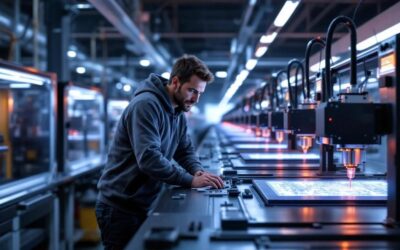
Let’s illustrate this with a concrete example: a production line in an electronic components factory was suffering from significant losses due to unplanned stoppages. By integrating a TeepTrak solution, the plant was able to track the causes of these stoppages in real time, apply targeted corrective measures and improve its OEE by 15% in six months. Detailed analysis revealed that downtime was mainly caused by machine adjustments and long start-up times, which were optimized through better planning and staff training.
For plant and production managers, taking action to improve OEE means first measuring performance indicators, then implementing structured continuous improvement projects. By relying on real-time monitoring tools, such as those offered by TeepTrak, manufacturers can quickly identify optimization levers and anticipate maintenance needs. This structured approach leads to significant gains in productivity, quality and cost reduction.
FAQ
Question 1: How can OEE be improved in a production plant?
Improving OEE involves identifying the causes of yield losses, such as unplanned stoppages and production faults. By adopting real-time monitoring solutions like TeepTrak, plants can analyze these causes and implement corrective strategies to improve overall efficiency.
Question 2: How important is digitalization for the OEE?
Digitizing the shop floor enables precise, real-time monitoring of equipment efficiency. This makes it possible to quickly identify problems and optimize processes, which is fundamental to improving OEE in a sustainable way.
Question 3: What impact does OEE have on production costs?
OEE has a direct impact on production costs by minimizing losses due to downtime, quality and speed. Greater efficiency leads to lower production costs, thus increasing profit margins.

0 Comments