
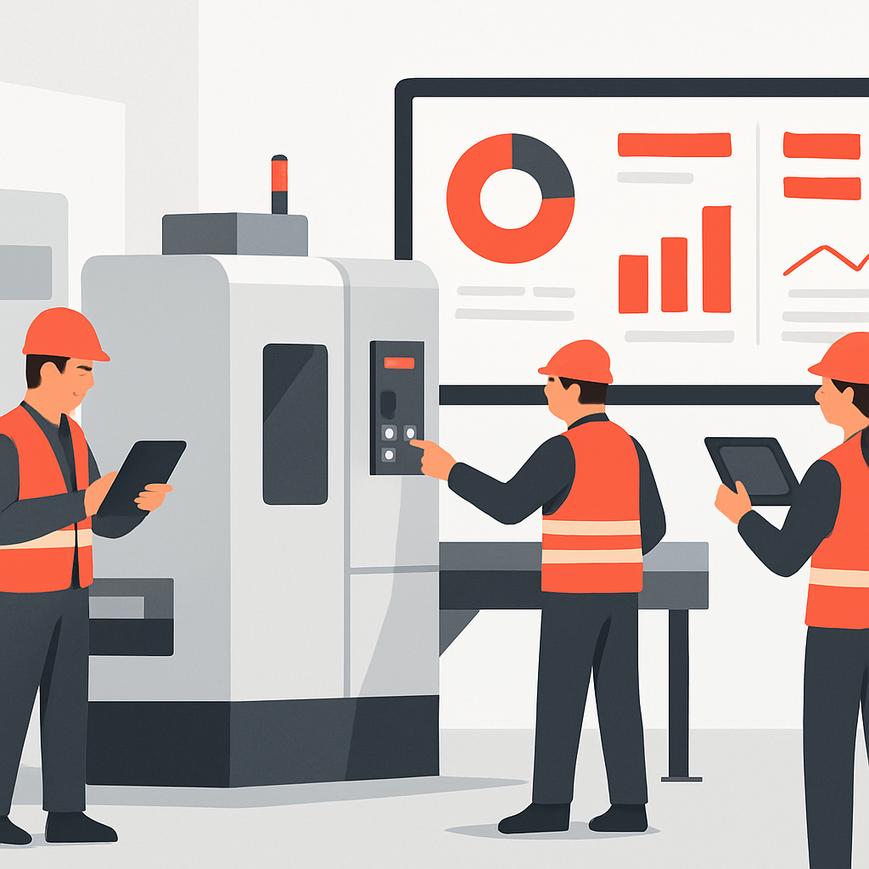
In today’s industrial context, understanding and optimizing OEE (Overall Equipment Effectiveness) has become crucial to keeping plants running smoothly. The main challenge facing industrial managers is to maximize equipment utilization while minimizing downtime, which has a direct impact on productivity and profitability. OEE enables these key parameters to be measured, making it an indispensable tool for guiding performance improvements on production lines.
OEE analysis often reveals several underlying causes affecting equipment performance. Frequent breakdowns, excessively long changeovers, or product quality defects are all factors which reduce the OEE score. These problems lead to substantial losses, impacting both unit production costs and overall added value. Without proper measurement, these inefficiencies remain difficult to identify and remedy.
Fortunately, there are many ways to improve OEE. The implementation of continuous improvement methods such as Lean Manufacturing, coupled with the digitization of the shop floor, is often the ideal solution. Tools such as
For example, an automotive parts plant recently used OEE to transform its operations. Initially, its OEE was 60%, mainly due to variability in machine performance and product non-conformance. By adopting real-time monitoring with TeepTrak, the plant was able to identify the main points of failure, correct them, and finally achieve an OEE of 85%. This example demonstrates the tangible impact that OEE monitoring and optimization can have on overall industrial performance.
To succeed in this type of transformation, it’s crucial to start with an accurate assessment of your current OEE. Prioritize initiatives that will stabilize and improve operations, while ensuring adequate staff training. By structuring a robust project around OEE, you can quickly see substantial benefits. To take things a step further, consider digitizing your production with TeepTrak to strengthen your continuous improvement management.
FAQ
Question 1: How can I improve OEE in my plant?
Improving OEE means reducing the causes of production losses: breakdowns, speed variations or quality defects. Implementing real-time monitoring solutions like those from TeepTrak can help identify and solve these problems.
Question 2: What are the advantages of OEE for a plant?
OEE provides a clear view of equipment performance, making it easy to identify inefficiencies. It helps to optimize production, reduce costs, and improve the quality of finished products.
Question 3: Where to start measuring OEE?
To measure OEE, start by collecting the essential data: availability, performance and quality. Then use tools like TeepTrak to analyze and visualize this data in real time.


0 Comments