
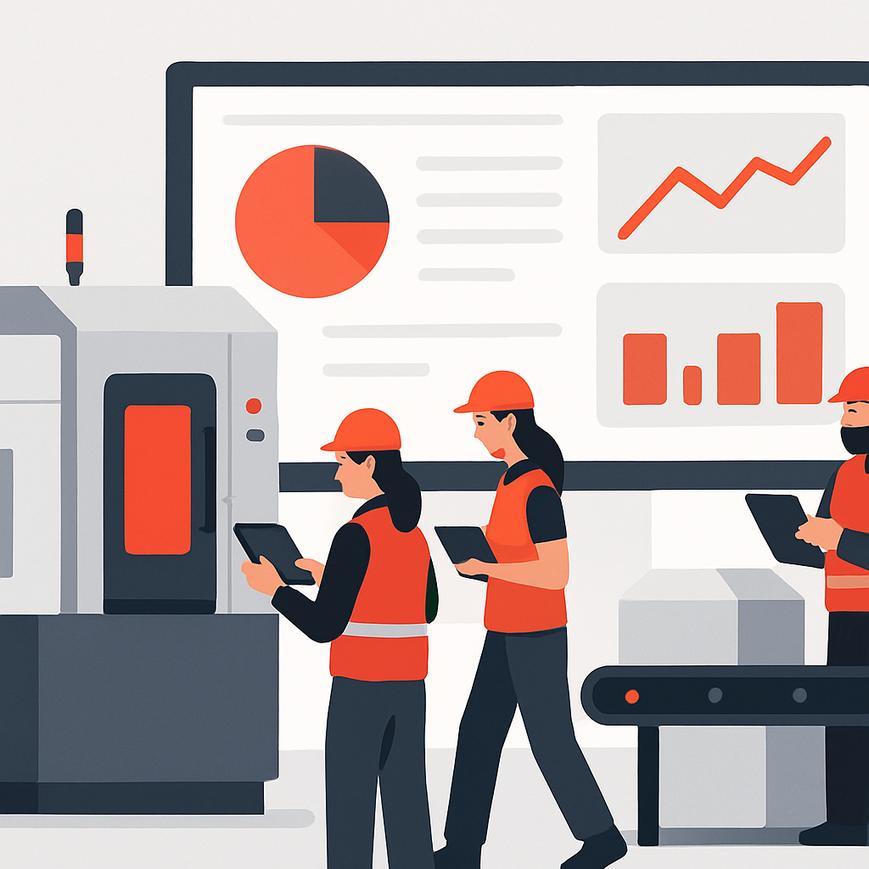
Understanding the various terms in TRS/OEE (Overall Equipment Effectiveness) is essential for manufacturers wishing to improve the productivity of their production lines. OEE measures the overall efficiency of equipment, taking into account availability, performance and quality. In an increasingly competitive environment, a lack of understanding of the terms and associated calculations can limit a plant’s ability to achieve its continuous improvement objectives.
The causes of this misunderstanding often lie in the complexity of the indicators, lack of training or misperception of actual performance. This can lead to misinterpretation of data, unplanned downtime, and ultimately increased costs. As a result, plants struggle to achieve an optimum balance between productivity and efficiency, impacting on their profitability.
To remedy this situation, the digitalization of the shop floor is proving to be a powerful lever. Tools such as those offered by TeepTrak enable real-time monitoring and precise analysis of production stoppages. By training staff in the fundamentals of TRS/OEE and adopting automated measurement solutions, plants can transform their performance.
For example, thanks to the TeepTrak solution, an automotive manufacturing plant was able to reduce its downtime by 10% and improve its OEE by 15% in six months. By identifying bottlenecks and implementing appropriate action plans, the company optimized its operations, seeing both an improvement in quality and a reduction in material losses.
In conclusion, for industrial decision-makers, mastering OEE terms is the key to a successful continuous improvement strategy. By integrating real-time monitoring and analysis solutions like TeepTrak, they can not only identify areas for improvement, but also track their progress in real time. Start today with an audit of your OEE performance and launch a dedicated project to maximize your gains.
FAQ
Question 1: How do OEE terms influence industrial performance?
OEE terms help plants measure production efficiency by identifying losses related to availability, performance and quality. This enables precise analysis and steering of improvements.
Question 2: What impact does OEE have on production costs?
An optimized OEE reduces costs by minimizing waste and unplanned downtime, thus increasing equipment efficiency and overall operating profitability.
Question 3: Where do I start to improve my plant’s OEE?
Start with an audit of your equipment to identify losses, then implement a real-time monitoring system like TeepTrak to effectively measure and drive your continuous improvement actions.


0 Comments