
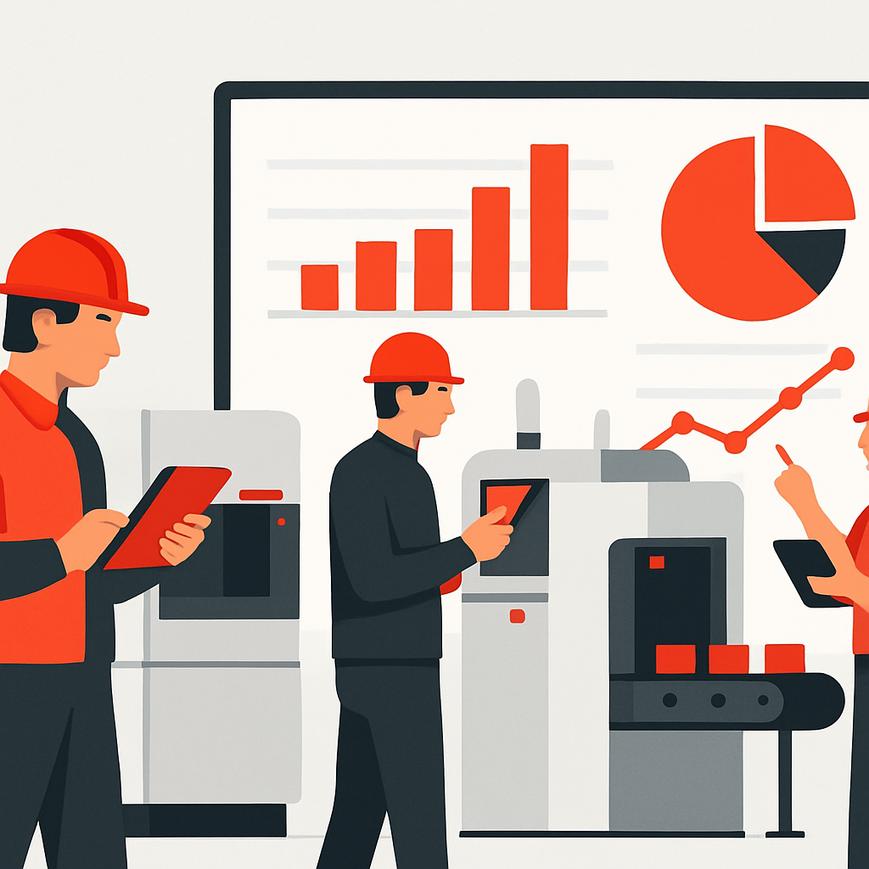
In today’s competitive manufacturing environment, optimizing overall equipment efficiency (OEE) is of strategic importance. The OEE calculation graph provides valuable visibility into equipment performance, enabling plant managers to quickly identify bottlenecks and inefficiencies. Understanding the data from these graphs is therefore essential to any industrial performance strategy.
Problems associated with the misinterpretation of OEE calculation graphs often include incomplete analyses of downtime, production and quality losses. These errors can lead to inappropriate decisions which directly affect productivity. For example, underestimating a performance problem can lead to higher operating costs and delivery times, undermining the plant’s competitiveness.
To overcome these challenges, it’s crucial to adopt a methodical, tool-based approach. By integrating digitalization solutions like TeepTrak, you gain visibility across multiple production lines, and can analyze the efficiency of your equipment in real time. The use of relevant indicators such as TRS/OEE, combined with a continuous improvement method, enables you to precisely target areas of waste. This helps to reduce downtime and increase quality.
A concrete example of the application of an OEE calculation graph can be illustrated by an automotive parts production plant. By implementing the
Taking action on OEE has never been so crucial. Implementing a structured project around TRS/OEE tracking can unlock significant gains, not only in terms of cost savings, but also in terms of capacity growth and customer satisfaction. By leveraging real-time tracking solutions such as PerfTrak OPC UA, you can turn your data into levers for action, and make continuous improvement a pillar of your industrial strategy.
FAQ
Question 1: How can an OEE calculation graph improve productivity?
An OEE calculation chart helps identify inefficiencies and bottlenecks on production lines. By visualizing this data, teams can quickly target areas requiring improvement to boost overall productivity.
Question 2: What tools can I use to monitor OEE in real time?
Solutions like TeepTrak offer real-time OEE monitoring, enabling continuous monitoring and optimization of equipment performance.
Question 3: What are the advantages of good OEE monitoring for a plant?
Good OEE monitoring can reduce downtime, improve production quality, cut operating costs and boost the plant’s competitiveness in the marketplace.



0 Comments