
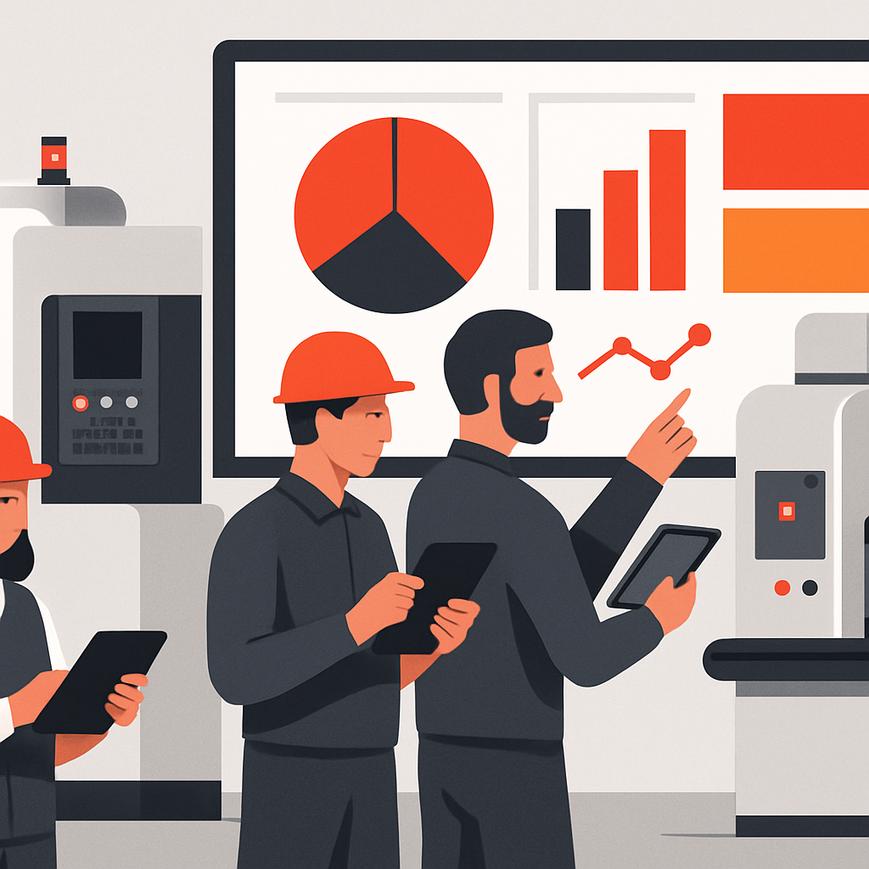
In today’s industrial context, optimizing equipment efficiency has become crucial to staying competitive. Using a tool like the Ignition OEE Dashboard, we can measure OEE (Overall Equipment Effectiveness) and visualize how industrial plants are actually performing. The challenge here is to understand how to interpret this data and identify areas for improvement in order to maximize productivity and reduce costs.
The causes of sub-optimal performance can be many: poorly calibrated equipment, unplanned downtime, speed losses or quality defects. These problems have a direct impact on OEE, resulting in lower productivity and higher production costs. This low efficiency increases the need for corrective rather than preventive maintenance, hampering industrial planning.
To address these concerns, shop floor digitization is proving to be an effective solution, thanks in particular to platforms such as TeepTrak. The implementation of continuous improvement practices and the use of real-time monitoring tools, such as the Ignition OEE Dashboard, make it possible to analyze stoppages, offer multi-line visibility and optimize OEE management. Key indicators include availability, performance and quality.
A case in point is an auto parts production workshop which, by analyzing their Ignition OEE Dashboard, was able to identify that delays were mainly due to unplanned downtime on a critical machine. By integrating TeepTrak for real-time monitoring, the plant implemented a preventive maintenance program that reduced breakdowns and improved OEE by 15% in just six months.
In conclusion, to benefit from OEE dashboards like Ignition’s, it is essential to measure performance accurately and regularly, analyze the data collected and structure an OEE optimization project. By starting with an audit of current processes and using high-performance tools such as TeepTrak to monitor progress in real time, gains can be substantial, boosting competitiveness in the marketplace.
FAQ
Question 1: How can I use the Ignition OEE Dashboard to improve performance?
Use the dashboard to analyze the causes of downtime, identify performance trends and measure the impact of corrective actions. This enables you to target areas requiring improvement.
Question 2: What impact does OEE have on a plant’s competitiveness?
A high OEE means efficient use of resources, reducing production costs and increasing quality. This improves competitiveness by optimizing productivity and better meeting market demands.
Question 3: Where do I start to implement an OEE improvement project?
Start with an audit of current processes to identify inefficiencies. Use a tracking tool like TeepTrak to monitor OEE in real time, and implement improvements based on the data collected.


0 Comments