
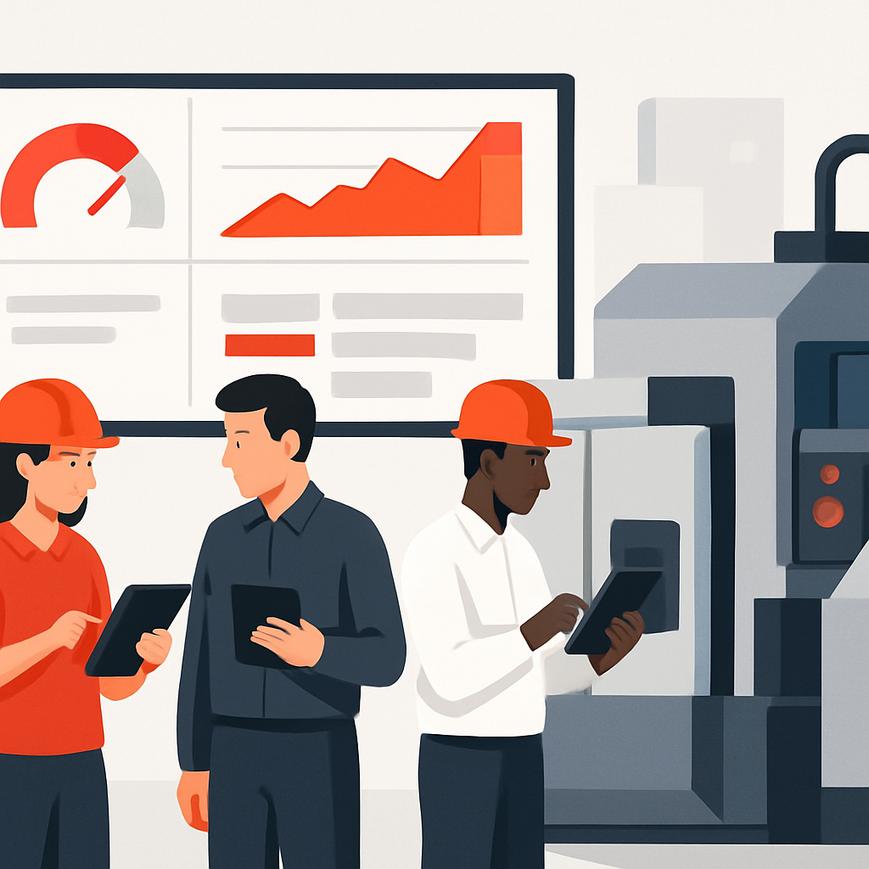
Improving overall equipment efficiency, also known as OEE (Overall Equipment Effectiveness), is a priority for operational leaders and plant managers. The key challenge is to ensure optimum productivity while minimizing losses and downtime. A thorough understanding of OEE is essential to detect gaps in production processes and prioritize the changes needed to achieve high levels of performance.
Several factors can negatively influence OEE, including frequent breakdowns, inefficient machine configurations and production defects. These factors lead to a reduction in OEE (Overall Equipment Effectiveness), directly affecting production costs and quality. Poor OEE control can also blur visibility of bottlenecks, making it difficult to identify areas requiring improvement.
To overcome these challenges, it is imperative to digitalize the shop floor and adopt real-time monitoring solutions, such as those offered by TeepTrak. The use of well-defined performance indicators, combined with continuous improvement methods such as
A concrete example of success is that of an electrical component manufacturing plant which saw a significant reduction in downtime after implementing a real-time OEE solution with TeepTrak. This approach made it possible to analyze machine downtime and identify corrective measures for each production line. In less than six months, the plant saw its overall OEE rise from 65% to 82%, demonstrating the tangible benefits of process digitization.
In conclusion, increasing your OEE becomes a strategic lever for increasing the competitiveness of your facilities. Initiating an OEE/ROS improvement project by integrating TeepTrak’s digital solutions means you can count on continuous improvement and increased visibility of your production. For best results, start by assessing and measuring your current performance with a suitable tool, and develop a progressive action plan that combines technology and Lean methodologies.
FAQ
Question 1: How can OEE be optimized in a production plant?
To optimize OEE, start by measuring losses, adopt real-time tracking solutions like those from TeepTrak, and implement continuous improvement processes.
Question 2: What are the impacts of low OEE on a production line?
Low OEE means higher costs, lower product quality and difficulties in identifying and resolving production bottlenecks.
Question 3: Why should I digitize my production to improve OEE?
Digitization enables real-time monitoring, precise analysis of stops and better visibility of multi-line performance, facilitating informed decisions to improve OEE.
0 Comments