
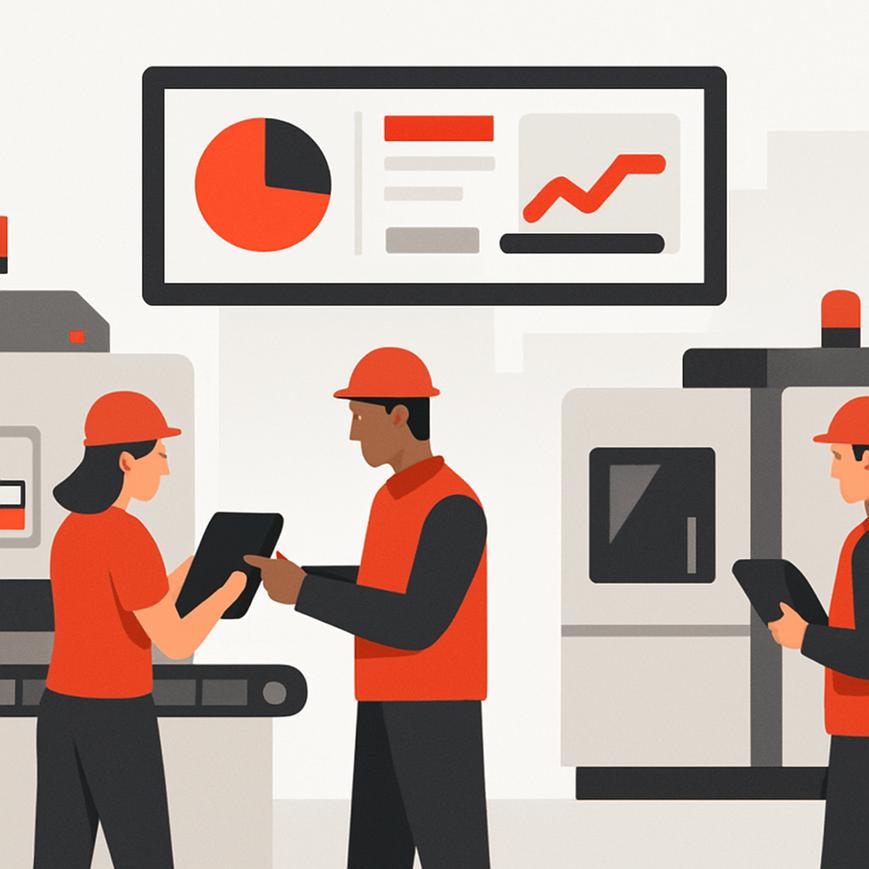
In today’s industrial context, improving overall equipment efficiency (OEE) is crucial to staying competitive. However, a major challenge facing plants is knowing how many losses to consider when calculating OEE. Indeed, accurate identification of losses is essential to obtain a reliable diagnosis of production performance and bottlenecks, directly influencing productivity gains and downtime reduction.
The causes of the problem lie mainly in a lack of understanding of the types of losses affecting OEE: unplanned stoppages, reduced speed and quality defects, among others. These losses, which are often poorly quantified, lead to an underestimation of production line capacities and higher operating costs. Lack of clarity on these elements can distort analysis and hinder rigorous monitoring of performance indicators such as OEE (Overall Equipment Effectiveness).
To overcome these obstacles, it is imperative to adopt a strategy based on continuous improvement and digitalization of the shop floor, supported by solutions such as TeepTrak. This approach enables real-time monitoring and enhanced visibility across all production lines. By clearly identifying loss categories using digital tools, managers can not only better understand the impact of each type of loss, but also prioritize waste reduction initiatives.
A concrete example illustrates the effectiveness of such an approach. A manufacturing company specializing in automotive parts set up a real-time tracking system with TeepTrak to identify and analyze its losses.
For plant managers looking to kick-start this type of initiative, it’s essential to first measure and categorize all losses, then leverage this data to implement targeted OEE improvement projects. Tools like TeepTrak facilitate this process by providing real-time downtime analysis and multi-line visibility. Embarking on a structured OEE/ROI project enables you to anticipate significant gains in productivity and quality.
FAQ
Question 1: What are the main losses to be considered in the OEE?
The main losses to consider include unplanned stoppages, reduced speed and quality defects. These categories cover the majority of inefficiencies that can be measured to optimize performance.
Question 2: How can we improve OEE calculations in a plant?
Improving OEE calculation requires a structured approach: accurately measuring loss categories, using real-time tracking systems like those offered by TeepTrak, and applying continuous improvement methods to reduce inefficiencies.
Question 3: Where do I start structuring a TRS/OEE project?
We recommend starting with a detailed analysis of current losses, followed by the implementation of real-time monitoring tools to effectively manage the project. Identifying and prioritizing potential gains will facilitate the achievement of tangible results.


0 Comments